
Agree what starts and stops the production clock
“Lead time” can refer to different intervals. One quotation may start at an initial inquiry; another may start only after final approval, agreed commercial conditions and material readiness. The end point may be assembly completion, inspection clearance, dispatch readiness or delivery. Those are different promises.
Ask the production contact to state the trigger for the proposed schedule. Identify the product version, quantity breakdown and unresolved requirements behind the estimate. A date without its assumptions is difficult to use when a launch or customer delivery depends on it.
This page explains schedule dependencies rather than giving a fixed number of days. The timing for a BDBRIM order needs to be confirmed against its design, materials, approvals and available production arrangement.
Keep development, production and transit separate
| Phase | What makes the next phase possible | Buyer question |
|---|---|---|
| Development and approval | The intended construction and final reference are agreed. | Which decisions remain open, and who can approve them? |
| Production readiness | Required materials, trims, artwork and order conditions are ready for the agreed route. | What is confirmed, and what is still an assumption? |
| Manufacturing | The approved version moves through its production operations. | Which handoff is complete, and what is the next dependency? |
| Inspection and packing | The required checks are cleared and the correct goods are prepared for dispatch. | Are any findings, labels or packing details unresolved? |
| Transport and arrival | The shipment is handed over under the agreed transport arrangement. | Is the date a dispatch target or an arrival estimate? |
Some preparation can run in parallel where the necessary inputs are confirmed. That does not remove approval gates. The party responsible for the route should identify which work can proceed and which work must wait.
Materials and versions determine readiness
Material availability concerns the specified material and color, rather than an approximate substitute. Closures, labels, thread and packaging can also be dependencies. If a substitution is proposed, agree it before treating the item as ready. A change that looks small in a photograph may still affect the approved product.
Multiple styles or colors create separate groups of preparation and approval. A total quantity alone does not describe every requirement. The schedule needs the breakdown and the relevant version for each group, especially when decoration or trims differ.
Keep confirmed facts separate from expected dates in an update. For example, “material received” and “material expected” represent different levels of readiness. Ask what evidence or confirmation is available for an unresolved input rather than assuming that all preparation began when the inquiry was sent.
Work in progress is not the same as an available production slot
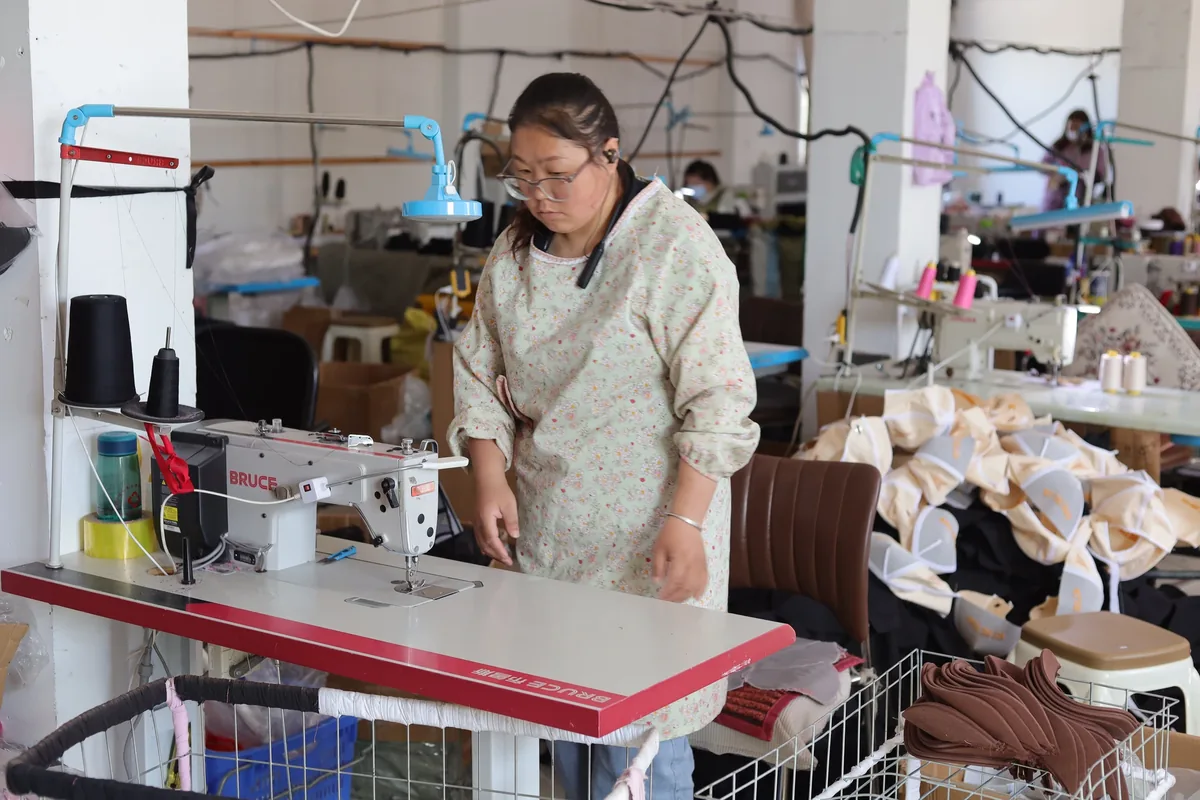
Components beside a sewing station show work in progress. They do not reveal the schedule for a new order, how much work remains or which resources are available. The photograph on this page should not be read as evidence of a current backlog or a delivery commitment.
For the actual order, ask how the decoration and sewing route will be arranged and which inputs need to be ready for each operation. A cap waiting for decorated components cannot be completed merely because sewing has started on other pieces. The handoff guide explains these dependencies.
If the proposed schedule relies on a particular allocation of work, confirm when that allocation will be agreed and what could change it. Avoid treating a workshop overview as a substitute for an order-specific production update.
A late change needs a new schedule assessment
Changing artwork, color, a closure or packing instructions can affect different stages. First identify what has already been approved, purchased, decorated, assembled or packed. The same change can have a different consequence depending on when it is requested.
Ask which work can still be used, what needs replacement or correction and which approval is required before continuing. Record the affected product revision and the revised date or condition. A schedule should not silently continue to refer to a superseded version.
If only part of the order is affected, confirm whether the groups can be handled separately and what that means for packing and transport. A partial shipment or split release needs explicit agreement; it is not automatically an available solution.
Use a short milestone record instead of one unexplained date
| Milestone | What the update should identify |
|---|---|
| Version approved | Reference/revision, approval date and the person authorized to approve changes. |
| Inputs ready | Materials and trims confirmed, outstanding items and the owner of the next action. |
| Production handoff | The completed operation, affected styles/colors and what the receiving operation still needs. |
| Inspection cleared | Inspection scope, disposition and any correction or recheck still open. |
| Dispatch ready | Goods packed to the agreed assortment and remaining transport handover requirements. |
For each open milestone, record the expected date, the condition that could change it and who will provide the next confirmation. This is a planning format, not a report of a live BDBRIM order. Read the quality-control guide for the checks that can affect release.
Plan backward from the arrival requirement, then reconfirm repeat orders
If you need goods at a destination by a certain date, share that requirement separately from the requested dispatch date. Transport booking, transit, customs and local handover belong in the delivery plan. The agreed production schedule alone does not establish the arrival date.
A repeat order still needs a version and readiness check. Confirm that construction, materials, artwork, trims and packing remain the same, and identify any change since the previous order. A historical schedule does not guarantee the next one when inputs or production arrangements have changed.
Send the relevant product reference, the style/color breakdown, the approval status and the destination date you need assessed. See BDBRIM’s workshop evidence and business contact for context. The next useful step is an order-specific schedule with clear assumptions.
Photograph sources and scope
Photographs supplied by BDBRIM from its workshop and product archive. They show different examples, not one complete order. A photograph does not establish an inspection result, output capacity or delivery commitment.
- custom-cap-sewing-production-workshop-img-1852.webp: An operator beside a sewing machine with white cap components and stacked brown pieces nearby
The workshop page and original video identify the visible operations. Confirm requirements for your own order with the team.